Based in Jinan, Shandong, China | Serving clients worldwide

CISG Article 25 in a Chinese Court: When a Quality Defect Is Not a Fundamental Breach
‹
›
‹
›
CISG Article 25 defines a fundamental breach as one that causes the buyer detriment so substantial that it is deprived of what it was entitled to expect under the contract. In Guiding Case No. 107, the Supreme People's Court of China held that a quality defect which leaves the goods usable, or resaleable at a reasonable price, does not reach that threshold — even where the defect is admitted and the seller is in breach. The decision is the clearest statement in Chinese practice of where the line sits, and it settles two questions for a foreign buyer at once: an application to avoid the contract will usually fail on a commodity that still has a market, and a claim for damages survives regardless.
What follows is the case, the two judgments, the three reasons the Supreme Court gave for reversing the first, and the single drafting error that turned a winnable claim into a partial recovery.
Case source
Issuing authority: Supreme People's Court of the People's Republic of China
Publication: Guiding Case No. 107, 21st batch of guiding cases, issued 25 February 2019 (Fa [2019] No. 3)
Case name: Sinochem International (Singapore) Co., Ltd. v. ThyssenKrupp Metallurgical Products GmbH — dispute over a contract for the international sale of goods
First instance: Jiangsu Higher People's Court, (2009) Su Min San Chu Zi No. 0004, judgment of 19 December 2012
Appeal: Supreme People's Court, (2013) Min Si Zhong Zi No. 35, judgment of 30 June 2014
Source of text: Supreme People's Court guiding cases database and the Supreme People's Court Gazette
What the case decided, in one paragraph
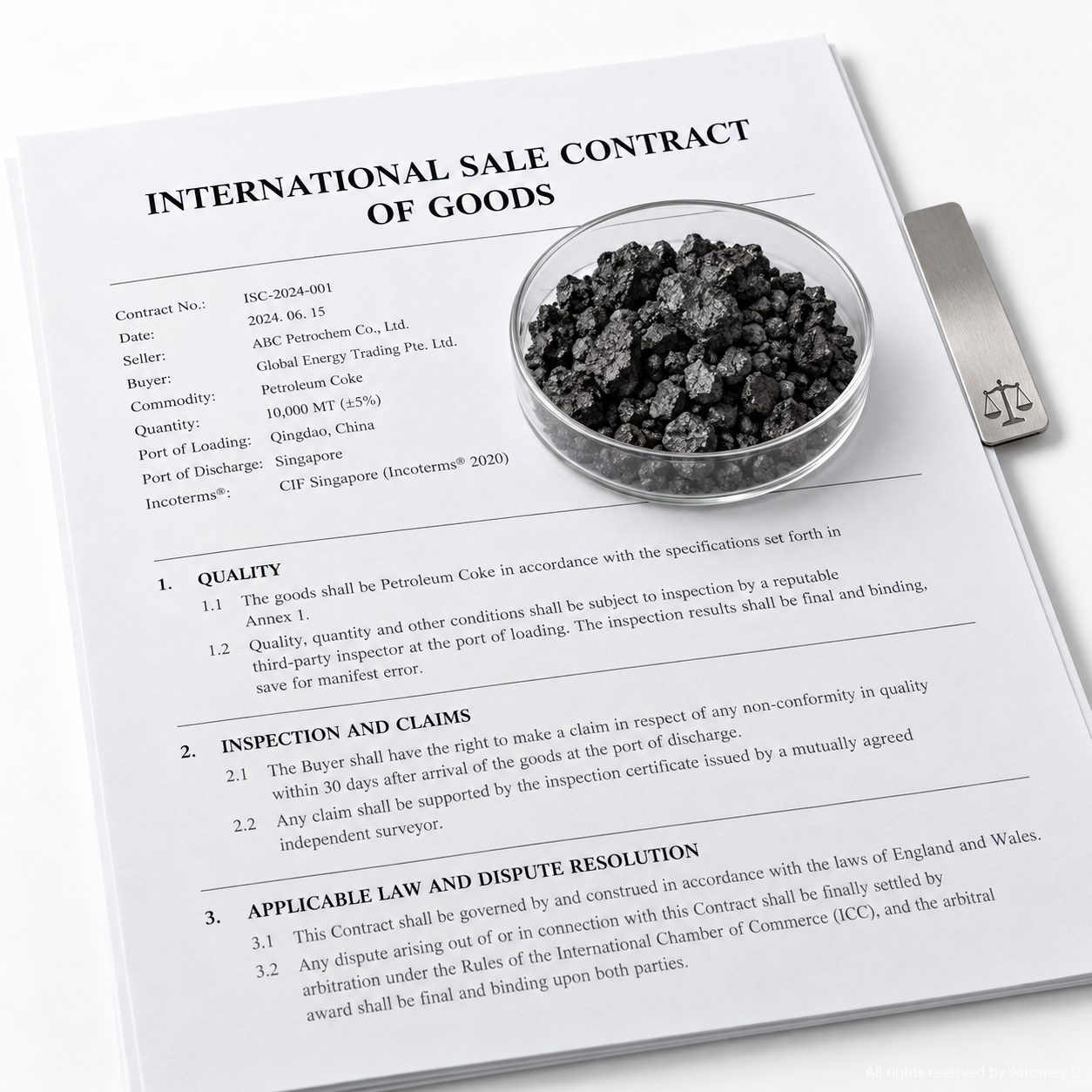
A seller delivered petroleum coke whose Hardgrove Grindability Index (HGI) was 32 against a contract figure described as typically 36 to 46. The buyer paid in full, declared the contract avoided, and sued for the return of the price. The Jiangsu Higher People's Court agreed with it. The Supreme People's Court did not: the coke could still be used, it had in fact been resold at what the buyer itself described as a price not below a reasonable market level, and one out-of-specification parameter out of seven does not deprive a buyer of what it was entitled to expect. The contract was not avoided. The buyer nevertheless recovered US$1,610,581.74 in goods loss and US$98,442.79 in storage costs, against US$2,684,302.90 paid.
The facts: seven specifications, one of them missed
On 11 April 2008 the parties signed a purchase contract for petroleum coke. The contract was expressed to be governed by, and construed under, the law of the State of New York then in force. The buyer paid the full price. The coke that arrived had an HGI of 32; the contract put the typical value between 36 and 46.
HGI measures how easily the coke can be ground. A lower index means a harder material and more grinding effort downstream. The contract dealt with seven characteristics in total — moisture, sulphur, ash, volatile matter, size, calorific value and hardness. The buyer took issue with hardness only.
Two facts about the buyer's conduct mattered more than anything in the contract. First, while the dispute was running, it resold the cargo. Second, in its correspondence with the seller it stated that the resale price was not below a reasonable market price. Both statements were treated as evidence about the nature of the defect: the goods had a market.
Two judgments, two different answers
The appeal did not overturn the finding of breach. The court was explicit that an HGI of 32 against a stated range of 36 to 46 is a failure to deliver goods in conformity with the contract. What it overturned was the characterisation of that failure — and, with it, the buyer's right to hand the goods back.
Why the Supreme Court reversed
Three reasons, and they are cumulative rather than alternative.
- Six of seven specifications were accepted. The buyer complained about hardness and nothing else. The court read the specification list as a whole and treated partial compliance as relevant to how serious the shortfall was.
- The goods still had use value. The evidence included an opinion from Shanghai University's School of Materials Science and Engineering, obtained by the buyer, which did not deny that coke with an HGI of 32 could be used; it said only that the uses were limited. Limited use is not no use.
- The buyer had resold, at a market price. A cargo that can be sold at a reasonable price is, on this reasoning, a cargo whose defect does not destroy the purpose of the contract. The buyer's own letter supplied the proof.
The rule the court drew from this is broader than the facts: where a buyer can, with reasonable effort, use the goods or resell them — even at some discount — a quality defect is not a fundamental breach. That formulation, not the outcome on the coke, is what Chinese courts now apply.
What the reversal did not take away: the money
Buyers read this case as a defeat. It is not. The buyer lost the right to hand the goods back, and it kept every money remedy the Convention gives it — two of which the court awarded, without the buyer ever proving that the contract should be undone.
The two routes are separate in the Convention. Avoidance under Article 49 is one remedy; damages under Article 45 are another, and they are alternatives, not a sequence. A buyer who fails on avoidance keeps:
- Damages under Articles 74 to 76, measured by the loss suffered, including the difference between contract price and cover price, or between contract price and market price.
- Price reduction under Article 50, which requires no proof of loss at all — only that the goods were not in conformity. On a commodity with a measurable quality differential, this is frequently the cheaper route, because it avoids expert evidence on the resale market.
- Storage, inspection and mitigation costs as consequential loss, which is how the US$98,442.79 in this case was recovered.
What the buyer loses by failing on avoidance is the right to return the goods and demand the whole price back. That is a real loss — it forces the buyer to fund the shortfall itself until damages are paid — but it is not the end of the claim.
The drafting point that decided the case: "typical" is not a specification
The contract described the HGI figure as a typical value between 36 and 46. That wording created two problems and solved none.
It made breach easy to establish: 32 was outside the range on any reading. But it made fundamental breach almost impossible to argue, because a typical value is a description of what the seller expects to produce, not a promise that every cargo will meet it. The buyer was left arguing that a departure from a description of typicality destroyed the purpose of the contract, while holding a cargo it had already sold.
A specification that is meant to bind should read as a warranty with a floor:
- A minimum or maximum, not a typical range. "HGI not less than 36" rather than "HGI typically 36 to 46".
- A named test method and the party who tests. The same cargo produces different numbers under different methods, and a specification without a method is open to argument at the first inspection.
- A sampling protocol. Who draws the sample, where, in whose presence, and what happens to the reference sample.
- An acceptance window and the consequence of missing it. Days from discharge, the notice required, and whether silence is deemed acceptance.
- An express remedy ladder. Price reduction first, replacement or repair second, avoidance only on stated thresholds. A ladder drafted in advance is what converts a quality argument into a number.
Article 26 sits behind this case, and buyers usually trip on it
The buyer in Guiding Case 107 sent letters to the seller quickly and repeatedly, and the courts accepted that a declaration of avoidance had been communicated in a reasonable time. That is not a detail. Under Article 26 of the Convention, a declaration of avoidance is effective only if made by notice to the other party, and Article 39 requires notice of a lack of conformity within a reasonable time after the buyer knew or ought to have known of it. A buyer who inspects, waits, negotiates and then sues has often lost both rights before the hearing begins.
The mechanics of those two periods — what counts as reasonable time, and how Chinese courts have measured it — are set out in CISG Articles 38 and 39: the notice deadline buyers miss.
What a buyer should do differently
The pre-contract checks that stop most of these problems arising are collected in the checklist to run before the first payment.
Frequently asked questions
Does this mean a Chinese court will never find a fundamental breach on quality?
No. The reasoning turns on whether the buyer retains what it contracted for. Goods that cannot be used for their ordinary purpose, goods that are unsaleable, seasonal goods delivered after the season, and goods that expose the buyer to regulatory seizure are all treated differently. The test is the extent of the deprivation, not the existence of a defect.
Can a buyer still reject the goods?
There is a difference between refusing delivery and avoiding the contract. Refusing a delivery that is visibly non-conforming is a factual act; avoidance is a legal remedy with a notice requirement and a threshold. Buyers who treat the first as if it were the second find themselves in breach for wrongful rejection.
Does the New York law clause matter?
It mattered only where the Convention is silent. Because Singapore, Germany and the United States were all contracting states, and neither party had excluded the Convention, the Convention applied to the sale. Questions the Convention does not regulate — validity, transfer of property — went to the chosen law. The court also held that the UNCITRAL digest of case law is not part of the Convention and cannot be applied as law, though it may be consulted.
Is this relevant outside petroleum coke?
Yes, and more than buyers expect. Any commodity sold on a "typical" specification — coal, ore, scrap, chemicals, agricultural products — raises the same question. The case is about how a quality figure is written, not about coke.
What if the contract says nothing about quality at all?
Then the question is no longer whether the defect is fundamental, but whether there was a defect at all. Article 35(2) supplies a default standard, and a 2025 Supreme People's Court case shows how narrowly a buyer's own national standard is read into the contract. That analysis is in how a Chinese court applies CISG Article 35 where no standard was agreed.
Before you argue about quality, establish what the contract promised
Send me the contract, the specification annex and the inspection records, and I will tell you which of these routes is open on your file: avoidance, price reduction, or damages — and what the likely recovery looks like after the cost of the procedure. The cost side is set out in what a Chinese supplier claim costs and what comes back, and the enforcement side in how to recover money from a Chinese supplier that stopped shipping. Where the honest answer is that the shortfall does not justify the procedure, that is what you will be told.
About the author
Li Xinlei (Aaron Li) is a partner at Beijing Huicheng (Jinan) Law Firm in Jinan, Shandong, where he acts for foreign companies and individuals in international trade disputes, cross-border enforcement and construction claims. He has five years of international engineering and market development experience in the Middle East and South Asia, and writes on China trade lawyer practice from the buyer's side — what to check, what it costs, and what can actually be recovered.
Source note: this article summarises Guiding Case No. 107 of the Supreme People's Court of the People's Republic of China, issued on 25 February 2019 in the 21st batch of guiding cases (Fa [2019] No. 3). The case name, docket numbers, dates, amounts and holdings above are taken from the published text of the guiding case and the Supreme People's Court Gazette. Company names appear because they are recorded in the published judgment.
Disclaimer: This article provides general legal information and does not constitute legal advice for any specific case. Procedural rules and judicial practice change, and the appropriate route depends on the facts of the individual matter. Please consult and appoint a qualified lawyer for your own case.
Related recommendations
China Full-time Lawyer&Attorney
Protect your china purchase and legal rights
RECENT POSTS
RECENT COMMENTS
Leave a Reply
Your email address will not be published. Required fields are marked *