Based in Jinan, Shandong, China | Serving clients worldwide
How to Recover Money from a Chinese Supplier That Stopped Shipping
‹
›
‹
›
You signed the proforma invoice. You wired the deposit. Then the messages stopped coming. If a Chinese supplier took your deposit and will not refund it, you are not in an unusual situation — I see this pattern repeatedly, across metals and ore, chemicals, and second-hand machinery and equipment. The commercial setting changes with the product; the mechanism does not. A supplier quotes sharply below the market, takes the deposit, and stops responding the moment the money lands. The practical question is not whether you have been wronged. It is how to recover money from a Chinese supplier when the company still exists, still has a bank account, and may still be shipping to someone else. (For the patterns that precede this stage, see my earlier note on Chinese supplier scam and fraud analysis.)
The short answer
Recovery depends almost entirely on one thing: whether the supplier still holds assets you can reach. If it does, a demand letter, an asset freeze and a claim can produce a real payment. If the company is a shell with an empty account, no lawyer can promise you anything, and the honest advice is to stop spending. Everything below is about finding out which of those two worlds you are in — quickly.
The question that decides your recovery
Most buyers approach this as a question of who is right. Chinese courts and arbitration tribunals approach it as a question of what can be collected. A company registered in 2021 with a registered address that turns out to be a shared office, a legal representative who is not the person who signed your contract, and no factory at the stated location is not a defendant worth suing — it is a defendant worth reporting. A trading company that has operated for eight years, exports regularly and banks with a provincial branch is a completely different proposition. Before you invest in a claim, establish which one you are dealing with. That single enquiry should come before any decision to litigate.
Step 1 — Build the evidence pack before you send anything
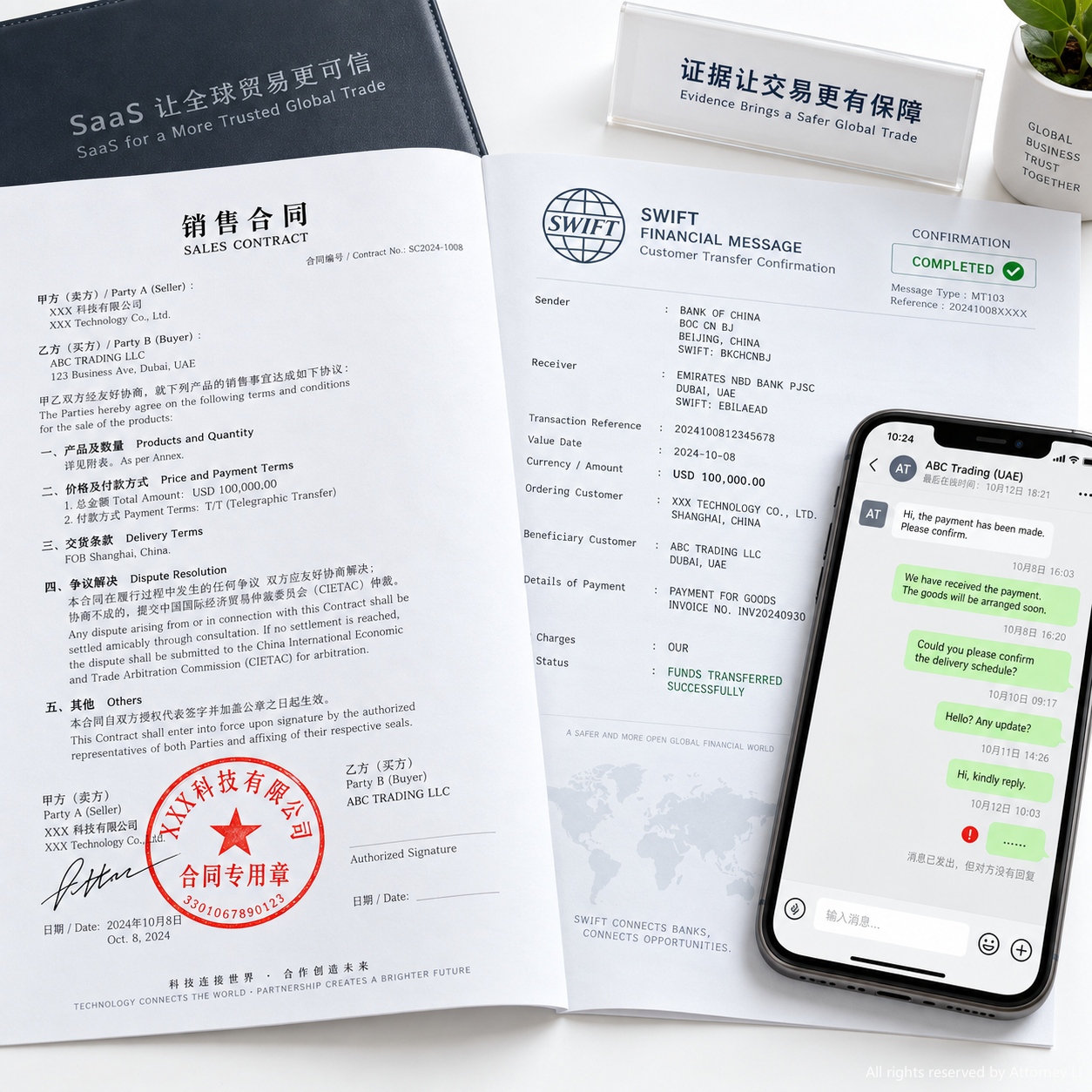
Chinese proceedings are document-driven. Oral accounts carry far less weight than they do in common-law systems, and a poorly assembled file limits your options before the dispute even begins. Collect, in one folder, dated and in original form:
- The signed contract or proforma invoice, with the supplier's company chop (the red seal) where available
- Proof of payment: the SWIFT confirmation showing the beneficiary name, account number and amount
- The full email thread, plus WeChat or WhatsApp records — screenshot them including the other party's ID or profile, not just the messages
- Product specifications, drawings, inspection reports and photographs
- The supplier's Chinese legal name and Unified Social Credit Code (the 18-character code on the business licence)
That last point matters more than most buyers expect. A claim in China must identify the defendant by its registered Chinese name. An English trading name, or a name the salesperson used informally, is not enough to file. If the entity that signed your contract, the entity that issued the invoice and the entity that received your money are three different companies, you need those relationships documented in writing now — because that mismatch is exactly what a respondent will use later.
Step 2 — Send a bilingual demand letter that creates a real deadline
A written demand is not a formality; in my experience it is the highest-yield step in the whole process. Send a letter in Chinese and English that states the payment date and amount, the agreed delivery date, a factual summary of the breach, the sum demanded, and a fixed deadline — seven to ten business days. Then send it two ways: by email, and by courier to the company's registered address as shown in the public company registry.
The physical letter matters. It tells the supplier that you have identified the legal entity and know where it is registered, which is precisely the information a shell operation does not want you to have. Suppliers who depend on continuing to trade will often respond at this point. If the supplier does respond and wants to settle, the enforceability question disappears — which is why I treat the demand stage as a genuine recovery channel rather than a prelude to court.
Step 3 — Find out whether there is anything left to take
At the same time, run an asset and capability check. Public sources in China allow you to confirm the company's registration status, its legal representative, its registered capital, whether it has been listed for abnormal operation, whether it has unsatisfied judgments against it, and whether it appears on the enforcement watchlists. What those records will not tell you is the company's bank balance. For that you need either a specific asset clue — an account number from an invoice or a prior payment, a factory address, a property holding — or a court-ordered enquiry once proceedings are under way. If you have nothing but a company name, say so early: it changes the strategy from “file and collect” to “file and investigate”.
Step 4 — Freeze the assets before you argue about the merits
This is the step that determines outcomes, and the step most guides skip. Chinese law provides for asset preservation (财产保全) — a court order that freezes or seizes a party's assets to prevent them being moved while the case is decided. It can be sought before proceedings begin, during proceedings, or after judgment. In practice:
- Before filing (pre-litigation): a fast route, but the court will normally require security covering the full value of the assets you want frozen, and you must commence court proceedings or arbitration within 30 days of the order, or it will be lifted.
- During the case: the more common route. Security is usually required, but is commonly capped at around 30% of the value preserved — this is why most buyers apply after filing rather than before.
- Urgency: where the situation is urgent, the court is required to rule within 48 hours of receiving the application.
- Duration: a freeze is not permanent. Bank deposits are typically frozen for up to one year, movable property up to two years, and real property up to three years. If the case is still running, the freeze must be extended before it lapses.
- What can be frozen: bank accounts, third-party payment balances, real estate, vehicles, inventory, machinery, equity and intellectual property — anything of value held in the respondent's name.
- The cost of getting it wrong: if the preservation was wrongful and caused the supplier loss, the applicant can be liable for that loss. This risk is normally managed with litigation guarantee insurance rather than cash.
The official application fee for preservation is low — in the region of a few thousand RMB. The real cost is the security. Freezing before the supplier knows a claim exists is often the difference between a judgment you collect and a judgment you frame.
Step 5 — Choose the forum: Chinese court or arbitration
Suing a Chinese supplier in the Chinese courts is workable where the assets are in China, but the process has fixed characteristics: foreign-language documents must be translated into Chinese by a qualified translator, your corporate identity documents and power of attorney must be notarised and legalised or apostilled, and jurisdiction will normally lie with the court where the defendant is domiciled or where the contract was performed. Major foreign-related cases generally go to an Intermediate People's Court.
If your contract contains an arbitration clause, the court will generally not accept the case at all and the dispute must go to arbitration. CIETAC arbitration is the usual choice in China, and for cross-border disputes many buyers prefer arbitration because awards travel better than judgments.
Enforcement, once you hold a judgment or award, runs through a separate application. The court can freeze and draw down bank accounts, seize and auction equipment and inventory, and — a lever that is used more often in China than most foreign creditors realise — place the company's legal representative and the company itself on the dishonest judgment debtor list, which restricts travel and high-end spending and imposes real commercial pressure. Where a party has no intention of paying voluntarily, this pressure, not the judgment itself, is frequently what produces money.
Why suing in your own country usually does not work
This is the most expensive misunderstanding in cross-border trade. China is not a party to the 2019 Hague Judgments Convention. Recognition of a foreign court judgment in China therefore depends on a bilateral judicial assistance treaty or on the principle of reciprocity — and while Chinese courts have become considerably more open on reciprocity in recent years, it remains uneven between courts and jurisdictions. A judgment obtained at home against a supplier whose assets are all in China is, in many cases, a document rather than a recovery.
Arbitration is structurally stronger. China has been a party to the New York Convention since 1987, and a foreign arbitral award is generally enforceable in China on a far more predictable basis than a foreign court judgment. That is the practical reason the dispute resolution clause in a supply contract matters so much more than most buyers assume when they sign it.
What you can realistically recover
When it is not worth pursuing
I tell clients this more often than they expect. For losses below roughly USD 10,000, the cost of a properly run China-side claim will frequently exceed what is recoverable, particularly if asset investigation is needed. In that band, the rational actions are a strong bilingual demand letter, a platform dispute if you transacted through one, and a written record — not litigation. Above that figure, the calculus changes quickly, and the first thing to establish is whether the supplier has assets at all. A realistic recovery assessment costs a fraction of a claim and can save the whole of it.
How to make the next order recoverable
Almost every deposit loss I have handled was, in hindsight, preventable at the contracting stage — and the fixes are inexpensive. Confirm that the company contracting with you, the company issuing the invoice and the company receiving the money are the same legal entity. Verify the entity and, where the order is significant, the factory, through due diligence before the first deposit moves rather than after a problem appears. Negotiate staged payments tied to production milestones or pre-shipment inspection. And put a dispute resolution clause in the contract that names a specific institution, a seat, a language and a cost-shifting rule — a clause that was pasted in from an unrelated template is the single most common reason a buyer who won on the merits still cannot collect.
Frequently asked questions
Can I recover money from a Chinese supplier if I never signed a formal contract?
Sometimes. A proforma invoice, a purchase order, payment records and a consistent written exchange can establish a contract in Chinese practice, and a proforma invoice signed or chopped by the supplier is commonly treated as evidence of the terms. The weaker link is usually identifying and reaching the correct legal entity rather than proving that a contract exists.
My Chinese supplier will not refund my deposit and has stopped replying. What is the first thing to do?
Preserve the evidence — payment confirmation, the contract, and the full message history — then obtain the supplier's registered Chinese name and Unified Social Credit Code. Until you can name the correct legal entity, no demand, freeze or claim can be directed at anyone.
The supplier did not deliver the goods but claims it will ship soon. Should I wait?
Waiting has a cost. Where the supplier is still trading and intends to perform, a written demand with a fixed deadline often restores momentum. Where it does not, delay mainly gives the supplier time to move assets. The two-year limitation period for applying to enforce is generous, but the window for freezing assets is not.
Can I sue a Chinese supplier without travelling to China?
Yes. A licensed Chinese lawyer can act on your behalf under a power of attorney, and you are not required to attend. Your identity documents and the power of attorney will need to be notarised and legalised or apostilled — a step that typically takes two to four weeks and should be started early.
Is arbitration or court better for a dispute with a Chinese supplier?
If your contract has a valid arbitration clause, arbitration is your route and the courts will not take the case. Arbitration awards are generally easier to enforce in China than foreign court judgments. If there is no clause, litigation in the competent Chinese court is normally the practical option — provided the supplier has assets in China.
If your supplier has taken the deposit and gone quiet, get a realistic read before you spend anything.
I offer a fixed-fee first-stage assessment: send me the contract, the proforma invoice, the payment records and the correspondence, and within 24 to 48 hours you will get a written view of whether there is a recoverable case, what it is likely to be worth, and what pursuing it would cost. No one can promise you a recovery — the outcome depends on the supplier's assets and the evidence — but you can find out where you stand before you commit to anything.
About the author
Aaron Li is a partner at H&C (Jinan) Law Firm in Jinan, Shandong, where he acts for foreign companies and individuals in international trade disputes, cross-border enforcement and construction claims. He has five years of international engineering and market development experience in the Middle East and South Asia, and writes on China trade lawyer practice for buyers rather than for search engines.
Originality statement: This article is based on matters handled by the author and is intended to provide general legal information and practical reference. For reprinting or citation, please indicate the original source (this website link / article link) and the author's information. We respect original creation and knowledge sharing, but firmly oppose any form of infringement.
Disclaimer: This article provides general legal information and does not constitute legal advice for any specific case. Cross-border disputes are fact-specific and the position in your matter may differ. Please consult and appoint a qualified lawyer for your own case.
Related recommendations
China Full-time Lawyer&Attorney
Protect your china purchase and legal rights
RECENT POSTS
RECENT COMMENTS
Leave a Reply
Your email address will not be published. Required fields are marked *