Based in Jinan, Shandong, China | Serving clients worldwide

WFOE or Hong Kong Company? A Decision Guide for First-Time Entrants
‹
›
‹
›
Posted October 11, 2026 · By Li Xinlei (Aaron Li), Partner, H&C (Jinan) Law Firm
The question arrives early and it is usually framed as a tax question. In practice it is a question about what you need to do on the mainland — invoice, employ, hold a licence, sign with local customers — and tax follows from the answer rather than leading it. Buyers who choose the structure before answering that question frequently end up with a Hong Kong company signing contracts it cannot perform in mainland China, or a mainland entity carrying compliance obligations it never needed.
The short answer
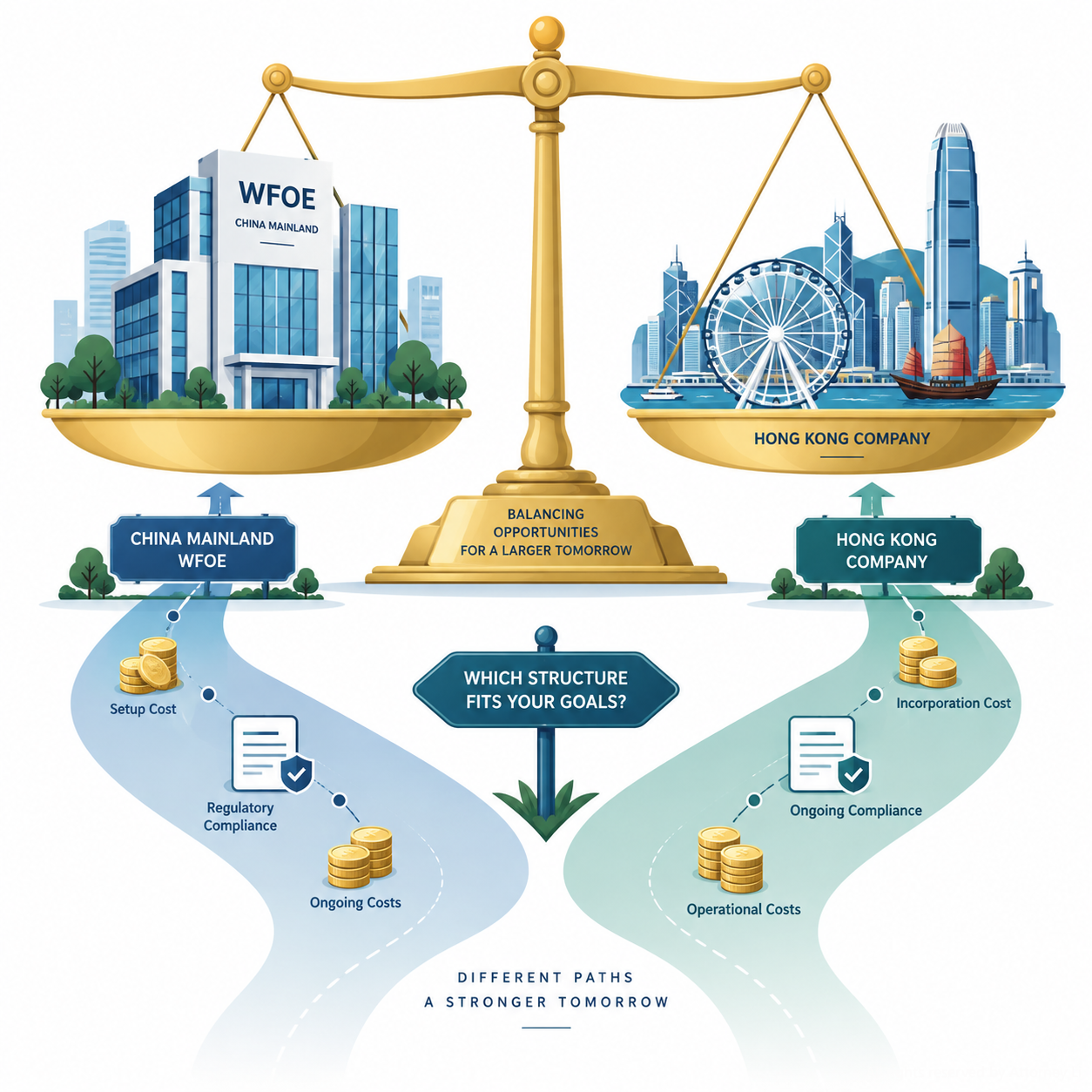
If you need to issue mainland invoices, employ staff in mainland China, hold local licences, or contract directly with mainland customers, you need a mainland entity — typically a wholly foreign-owned enterprise. If you need a holding, trading or treasury vehicle for cross-border flows and will not trade onshore, a company incorporated in Hong Kong SAR can do that work at lower cost and with far less mainland compliance. The two are not alternatives for the same job; they answer different questions.
What the two structures actually are
A wholly foreign-owned enterprise is a company established in mainland China, owned entirely by foreign investors. It is a Chinese legal person: it can conclude contracts in its own name, issue invoices, employ staff, hold assets, and repatriate profits after tax.
A company incorporated in Hong Kong SAR is a Hong Kong legal person. It is not a mainland entity and does not, by itself, give you any right to carry on business in mainland China. Hong Kong SAR is a special administrative region of China with its own legal and tax systems; incorporating there is straightforward and often useful, but it is not a mainland licence.
That distinction produces most of the confusion in this area, so it is worth stating plainly: a Hong Kong company is an offshore company from the perspective of the mainland. It is not a shortcut into the mainland market.
What a Hong Kong company can and cannot do on the mainland
The practical line is this: a Hong Kong company is good at moving money and holding equity. It is poor at transacting onshore. Attempting to use it for the second purpose is where most first-time entrants run into trouble — not because anything is unlawful, but because the structure cannot deliver what the business plan assumes.
The four structures people conflate
A representative office is the structure most often misunderstood in the other direction: it is cheap and simple, and it cannot earn revenue or sign commercial contracts on the mainland. It is a liaison and market-research presence, and nothing more.
How to decide
Work forwards from what the business will actually do:
- Will you invoice mainland customers in RMB? If yes, you need a mainland entity. This question alone determines the answer for most importers and service providers.
- Will you employ people in mainland China? If yes, a mainland entity is normally required, because social insurance and labour obligations attach to a mainland employer.
- Do you need a licence, permit or regulated qualification? Then the applicant must be a mainland entity.
- Are you holding equity in mainland operations, or receiving payments from mainland suppliers? A Hong Kong company is a conventional and efficient choice.
- Are you testing the market without committing capital? A representative office may be enough — provided you accept that it cannot generate revenue.
The answers commonly combine. A structure often used is a Hong Kong holding company above a mainland WFOE: the mainland entity trades and employs, while the Hong Kong entity holds the equity and handles cross-border treasury. That is a deliberate design, not a default, and it is worth taking advice before assuming it fits.
What each choice commits you to
A WFOE brings ongoing mainland obligations: registered capital contributed on the filed terms, foreign exchange registration, annual reporting, tax registration and filings, social insurance for employees, and a genuine cost of deregistration if the venture does not work. The obligations are manageable, but they are recurring and they do not lapse because the business is quiet.
A Hong Kong company brings Hong Kong obligations: annual filing, audited accounts, and compliance with Hong Kong's economic substance expectations, which have become more substantive in recent years. It also brings a structural limit — the mainland activities it cannot carry out.
Both sets of obligations are inexpensive relative to the cost of having chosen the wrong structure. The expensive error is not over-compliance; it is discovering, after signing mainland contracts, that the entity which signed them cannot invoice, employ, or enforce the arrangements the business depends on.
The two failures I see most often
The first is contracting onshore through an offshore entity. A company incorporated in Hong Kong SAR signs a supply or services contract with a mainland counterparty, performs the commercial work, and then cannot issue the invoice the customer needs to pay. The dispute that follows is as much about the structure as about the performance, and it is settled in a forum chosen by an entity that was never set up to be there.
The second is establishing a WFOE for work that does not require it. A company that only needed a holding vehicle creates a mainland entity, takes on recurring filings and social insurance, and acquires an orderly deregistration project when the market test concludes. The cost is not the set-up; it is the exit.
Where the retainer question enters
Structure decisions are episodic. What determines whether a structure continues to work is the ongoing flow of small decisions — a contract clause, a customer payment term, a supplier's request to change the beneficiary, an employee's contract — each of which is cheap to get right at the time and expensive to correct afterwards. That is the work a standing retainer for foreign companies in China is designed to cover, and it is worth understanding what it does and does not include before assuming it is the same as hiring a lawyer per matter.
Frequently asked questions
Can a Hong Kong company sign contracts in mainland China?
It can enter into contracts, but it cannot issue mainland VAT invoices, and it cannot employ staff on the mainland directly. For most businesses that means it cannot be the operating entity for onshore trade, even where the contracting itself is possible.
Is a WFOE always required to trade in mainland China?
For direct onshore trading with mainland customers, employing staff, or holding local licences, a mainland entity is required in practice. Where the role is cross-border — collecting export payments, holding equity — a Hong Kong company is often sufficient.
Is a representative office a cheaper version of a WFOE?
No. It is a different thing with a narrower purpose. A representative office cannot generate revenue or conclude commercial contracts on the mainland. It is suited to liaison and market research, and unsuitable as an operating structure.
Do I need a mainland entity if I only sell to mainland customers online?
Selling into the mainland and selling from within it are different activities, and the second generally requires a mainland entity, a local registration and a compliant payment arrangement. Assuming otherwise is one of the most common early surprises for first-time entrants.
Choose the structure from what the business must do, not from what it costs to set up
Send me a short description of what you intend to do in mainland China — who you will sell to, whether you will employ anyone, whether any licence is required, and where payments will be collected. You will get a written view of which structure the activity actually requires, what it commits you to, and what would need to change if the business model shifts.
→ Talk to me about your case (/contact_us.html)
About the author
Li Xinlei (Aaron Li) is a partner at H&C (Jinan) Law Firm in Jinan, Shandong, where he acts for foreign companies and individuals in international trade disputes, cross-border enforcement and construction claims. He has five years of international engineering and market development experience in the Middle East and South Asia, and writes on China trade lawyer practice for buyers rather than for search engines.
Originality statement: This article is based on matters handled by the author and is intended to provide general legal information and practical reference. For reprinting or citation, please indicate the original source (this website link / article link) and the author's information. We respect original creation and knowledge sharing, but firmly oppose any form of infringement.
Disclaimer: This article provides general legal information and does not constitute legal advice for any specific case. Market entry rules, tax treatment and regulatory requirements change, and the appropriate structure depends on the specific activities contemplated. Please consult and appoint a qualified lawyer for your own case.
Related recommendations
China Full-time Lawyer&Attorney
Protect your china purchase and legal rights
RECENT POSTS
RECENT COMMENTS
Leave a Reply
Your email address will not be published. Required fields are marked *