Based in Jinan, Shandong, China | Serving clients worldwide

CIETAC Arbitration: What Foreign Buyers Should Know
‹
›
‹
›
The short answer
CIETAC — the China International Economic and Trade Arbitration Commission — is the most widely used arbitration institution for contracts involving Chinese parties, and for a foreign buyer it is often a better forum than a Chinese court. Awards are enforceable internationally under the New York Convention, proceedings are confidential, and the tribunal can be chosen for relevant commercial experience rather than assigned by a roster.
What determines whether that advantage is real is almost entirely the arbitration clause. A well-drafted clause decides the institution, the seat, the language, the number of arbitrators and the applicable rules. A defective one can leave you arguing about procedure for a year before the merits are ever reached.
What CIETAC is, and when it applies
CIETAC is one of several arbitration commissions in mainland China; others include the Beijing, Shanghai and Shenzhen commissions, and the China Maritime Arbitration Commission for shipping matters. CIETAC handles the largest share of foreign-related commercial cases, and its rules are familiar to international practitioners.
CIETAC hears a case only if the parties agreed to arbitration and agreed, expressly or by reasonable inference, on CIETAC. It is not a default: if the contract names a court, or names arbitration without identifying an institution, the route is different, and in the second case the clause may be unenforceable depending on what the parties can be shown to have intended.
Why a foreign buyer might prefer arbitration
Three practical reasons, in order of importance for most buyers.
Enforcement. A Chinese court judgment is enforceable inside China, but its recognition abroad depends on treaty arrangements and reciprocity, which vary by jurisdiction. A CIETAC award travels under the New York Convention: if the defendant holds assets in a jurisdiction that is party to it, the award can generally be taken there for enforcement.
Confidentiality. Court proceedings are generally public. Arbitration is not, which matters when the dispute involves customer identity, pricing or a supplier relationship you may want to preserve.
Neutrality and control. The parties can agree the seat, the language and the composition of the tribunal. Where the defendant is Chinese and the seat is in mainland China, the practical advantage is smaller than the brochure suggests, but a clause choosing a seat outside China changes the picture substantially.
The clause decides almost everything
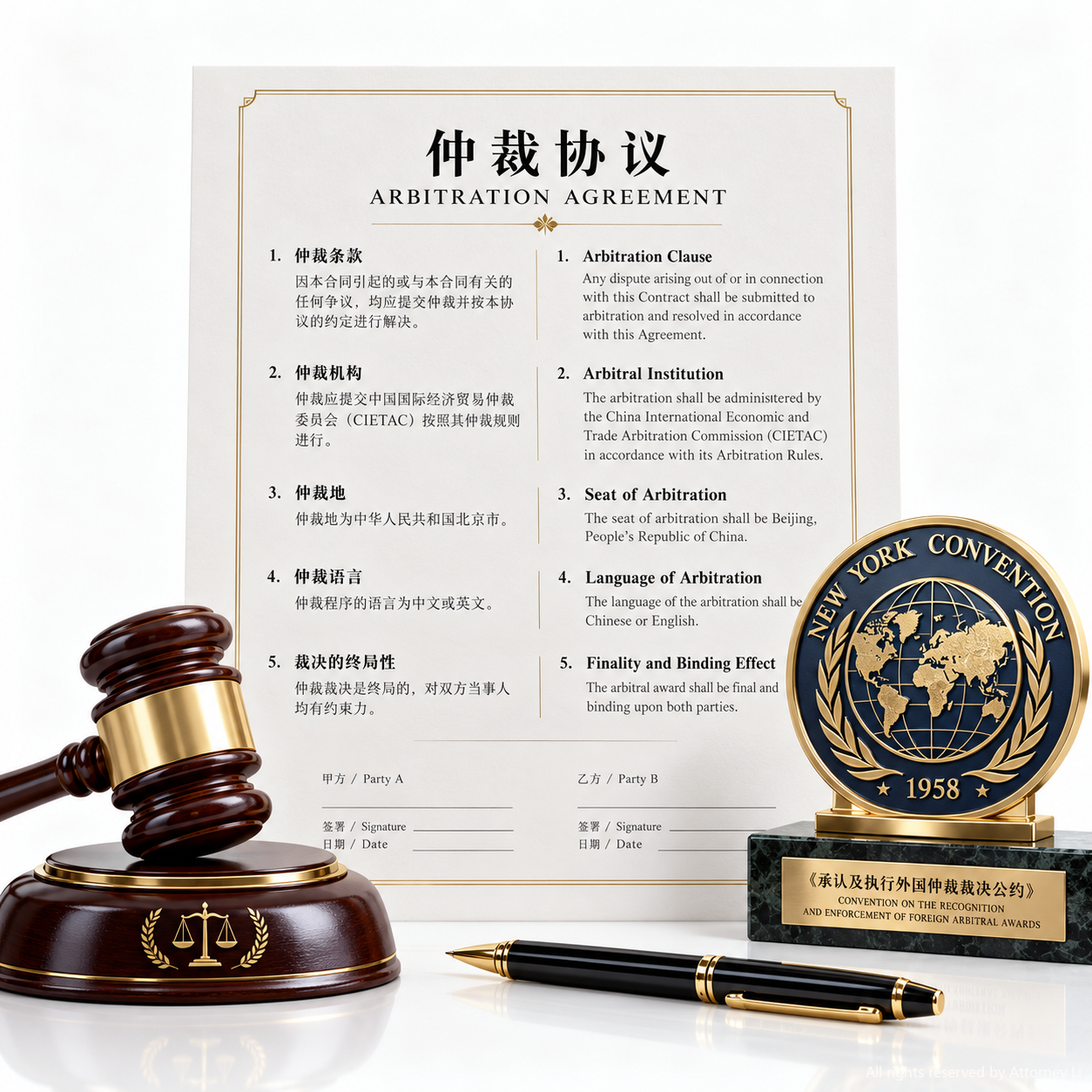
A workable clause names the institution, the seat of arbitration, the language, the number of arbitrators and the governing law. It looks like this in outline:
Any dispute arising out of or in connection with this contract shall be referred to and finally resolved by arbitration administered by [institution] under its rules in force when the notice of arbitration is submitted. The seat of arbitration shall be [place]. The language of the arbitration shall be [language]. The tribunal shall consist of [one / three] arbitrator(s). The governing law of the contract shall be the law of [jurisdiction].
Two omissions cause most of the damage. Naming no seat leaves the seat to be determined by the tribunal or the institution, which can produce a long preliminary fight. Deciding the seat but not the governing law leaves the substantive law of the contract to conflict rules — a costly way to resolve something that takes one line to specify.
How a CIETAC case runs
Commencing the arbitration
The claimant files a notice of arbitration with the commission, together with the claim and supporting materials. The commission reviews the request for conformity with the rules and the clause, then notifies the respondent. A respondent that disputes jurisdiction raises it at this stage, usually before the tribunal is constituted or at the latest in its first substantive submission.
Constituting the tribunal
In a three-member tribunal each party nominates one arbitrator and the two nominees, or the chairman of the commission, appoint the presiding arbitrator. In practice the chair has significant influence over how the case is run, which is why the choice of seat and the process for appointing the chair deserve attention at clause-drafting stage rather than after a dispute arises.
Evidence and the hearing
Chinese arbitration practice is documentary and comparatively familiar to parties used to civil-law procedure. Witness testimony is less central than in common-law proceedings, and documentary evidence carries most of the weight. Expert evidence — on quality, on quantum, on technical specification — is frequently decisive.
Documents in a foreign language generally require Chinese translation. Where a document's authenticity is contested, notarisation and legalisation or an apostille may be required. Assembling evidence in that form takes time, and it should begin as soon as a dispute looks likely rather than after the notice is filed.
The award
CIETAC awards are final and binding on the parties. A court may set aside or refuse enforcement of an award on limited grounds — typically procedural, such as an invalid agreement, improper composition of the tribunal, or a party being unable to present its case — but not because the tribunal got the facts or the law wrong. That constraint is the point of agreeing to arbitration.
Time and cost
CIETAC arbitrations are generally measured in months, not weeks. The commission's fees are calculated by reference to the amount in dispute and the number of arbitrators, and are published; the parties' own costs — counsel, translation, expert evidence, notarisation — usually exceed the administrative fees for a contested case. Buyer and claimant costs are typically not fully recovered even where you win.
Enforcing the award outside China
Enforcement is a second, separate proceeding conducted where the assets are. Courts in New York Convention jurisdictions apply a narrow set of grounds for refusing enforcement, and the burden is on the party resisting. In practice, the most common obstacles are practical rather than legal: identifying the assets, and doing so before they move. If enforcement abroad is likely, asset enquiries belong in the plan from the beginning, not after the award is issued.
Where parties lose ground before the hearing
- A clause that names two institutions. Ambiguity invites a jurisdiction fight, and you may lose the right to have the dispute heard where you intended.
- No seat. A procedural argument that consumes months and produces nothing.
- Notice given late. Under the international sale of goods regime, a buyer's duty to examine the goods and to give notice of defects within a reasonable period — CISG Articles 38 and 39 sit at the centre of this — is a substantive limitation, not a formality. A strong claim can be defeated by a late complaint.
- Missing the documentary chain. Purchase orders, proforma invoices, specification sheets and payment records that contradict one another are worse than gaps, because they invite the tribunal to prefer the defendant's version.
Questions buyers ask about CIETAC
Can I arbitrate without a clause that names CIETAC?
Only if both parties agree to submit the dispute after it arises. That agreement is often obtainable when a relationship is still workable, which is a reason to consider raising it quietly before positions harden. If it cannot be obtained, the forum depends on what the existing clause says.
Is Chinese law applied to a CIETAC arbitration?
Not automatically. The tribunal applies the law the parties chose for the contract; where none was chosen, it applies conflict rules, which in a China-seated arbitration will frequently lead to Chinese law. This is another reason to specify the governing law expressly.
Does arbitration exclude Chinese court proceedings entirely?
For the substance of the dispute, effectively yes. Courts still have a role in support of arbitration — interim measures, such as property preservation, may be sought through the courts in defined circumstances. That interface between the arbitration seat and the courts is worth planning for.
Where the contract is still being negotiated, the clause is the cheapest thing to get right and the most expensive to get wrong. Our cross-border dispute resolution and recovery practice covers clause review, arbitration conduct and enforcement of awards abroad.
Related recommendations
China Full-time Lawyer&Attorney
Protect your china purchase and legal rights
RECENT POSTS
RECENT COMMENTS
Leave a Reply
Your email address will not be published. Required fields are marked *