Based in Jinan, Shandong, China | Serving clients worldwide
10 Checks Before You Pay a Chinese Supplier a Deposit
‹
›
‹
›
The short answer
A deposit is the point of no return. Once the money leaves your account, your remaining options all cost more than the verification you skipped — negotiation from a weak position, arbitration, or litigation in a country you do not operate in. The ten checks below are mostly free, none of them is technically difficult, and together they take about an afternoon. They are ordered deliberately: checks about who you are paying come first, because a payment to the wrong entity is far harder to unwind than a shipment that disappoints.
Why the deposit is the moment that matters
In a typical first order the buyer carries the advance-payment risk and the seller carries the production risk. That is a normal allocation, and it is not the problem. The problem is that the buyer's remedies are back-loaded. Under the international sale of goods regime the buyer's duty to examine the goods and give notice of defects runs from delivery — CISG Articles 38 and 39 sit at the centre of that — so by the time a defect is visible, the deposit has long since cleared. Whatever leverage you had, you spent it before you knew there was anything to spend it on.
Verification is the one step that happens while the money is still yours.
The ten checks
1 — Match the bank account name to the registered company
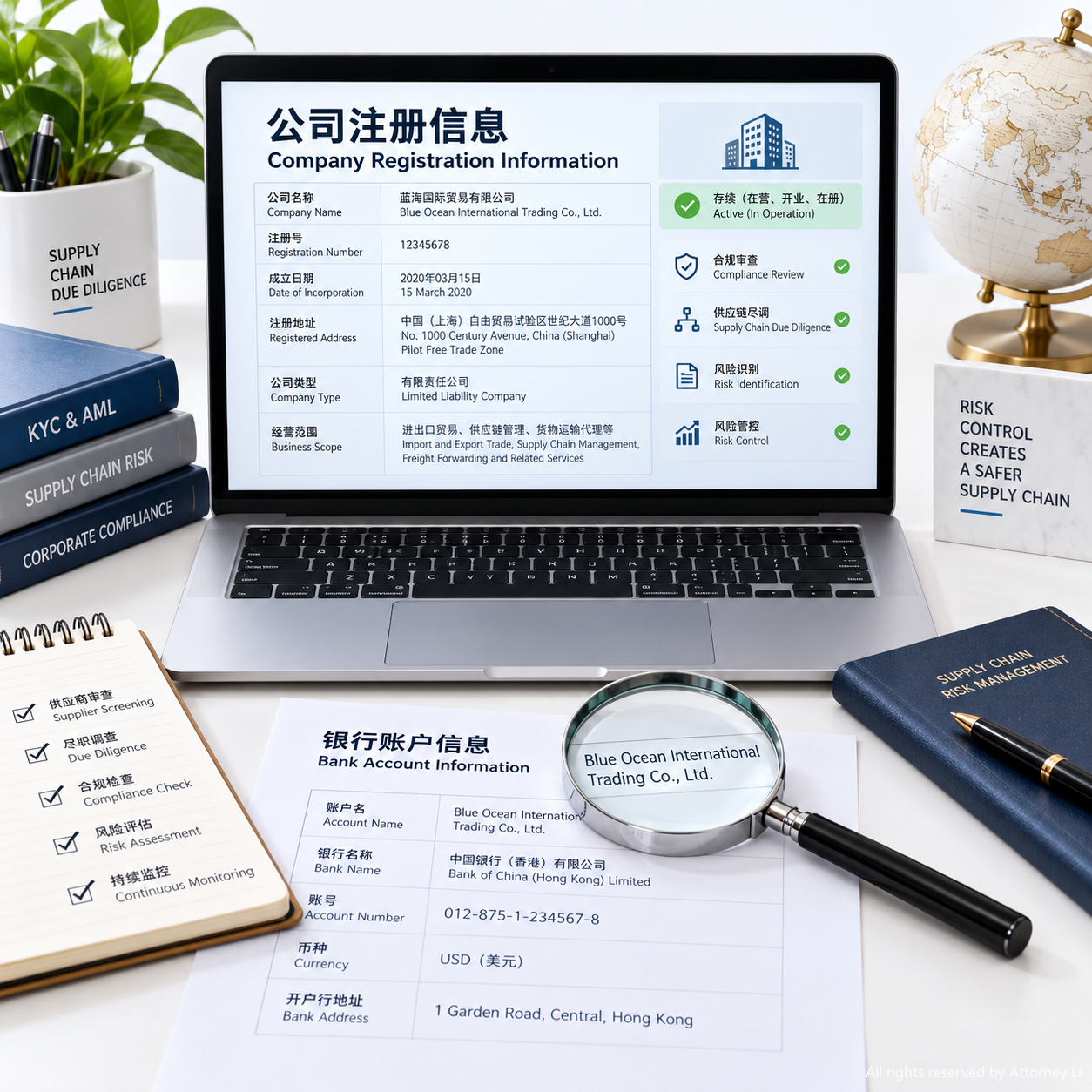
Ask for the registered Chinese name and the account name in the same message, and compare them character by character. If the beneficiary is a different company, an affiliate, a trading company or an individual, you are not paying your counterparty. You are paying a stranger who owes you nothing, and your contract gives you no direct claim against them. This single mismatch accounts for a large share of the unrecoverable losses buyers report.
2 — Confirm the company is still in operation
Status on the national credit registry should read 存续 or 在营. Revoked (吊销), cancelled (注销) or relocated out (迁出) means the entity you contracted with no longer exists in the form you believed. A company can trade under a name long after the registration behind it has been struck off.
3 — Check paid-in capital, not the registered figure
Since 2014 China has generally used a subscribed capital system. The registered figure is what shareholders committed to contribute, not money in the bank. A company displaying a very large registered figure may have contributed a fraction of it. What you want to see is the paid-in amount, the contribution schedule, and whether the contributions were made on time.
4 — Read the business scope
The business scope (经营范围) states what the company is licensed to do. It should cover the manufacture, processing or export of the goods you are buying. A company whose licensed scope runs to consulting or domestic retail is not a factory, however its website is written. Scope is also worth re-reading against the invoice: goods outside the licensed scope raise questions about the export documentation that will follow.
5 — Look for enforcement records and abnormal-operation listings
Two lists on the registry do most of the work. The abnormal operations list (经营异常名录) records failures to file returns or to maintain contactability. The list of dishonest judgment debtors (失信被执行人) records companies that have not satisfied court orders. The second is the most useful single signal available to a foreign buyer without local presence: it tells you that someone who won a case against this company still has not been paid.
6 — Find out who actually controls the entity
Read the shareholders and the legal representative, then compare them against the person negotiating with you. A sales manager with no shareholding and no directorship has no authority to bind the company, and may not be able to deliver on anything he agrees. Sales staff in the export trade turn over quickly; the entity does not.
7 — Ask what the company says it cannot do
Send two or three specific questions the marketing material does not answer: which production lines run the item you are buying, how many are on the premises, and who owns the tooling. A supplier that answers precisely is describing operations it knows. A supplier that deflects every question to the website is telling you the website is the substance.
8 — Obtain the bank details through a second channel
Never accept bank details that arrive only in the same email thread as the invoice. Confirm them by a separate route — a phone call to a number you held before the order, or a document you already have — and treat mid-order changes to the account as a red flag rather than an administrative detail. Payment-diversion schemes depend on the buyer simply updating the file.
9 — Put the specification in writing before the price is fixed
The specification should describe the goods by measurable criteria, reference a sample or drawing where one exists, and state the tolerance. Agreeing a price before the specification is settled is how a cheap quotation becomes an expensive dispute: both sides can honestly believe they are performing, while measuring different goods.
10 — Fix the inspection and notice window in the contract
The statutory notice periods in the sale of goods regime are short, and they run from delivery. If you intend to inspect on arrival, or at the factory before shipment, say so in the contract and give the examination a defined timetable. A buyer who discovers a defect outside the contractual window has a much harder argument, whatever the goods actually were.
If you have already paid
The checks still matter, and the order changes. The first question is who received the money — if it went to an entity other than your counterparty, establish what documents link the two, because that shapes every option that follows. The second is what the contract obliges and when, because a claim needs a defined breach and a date. The third is whether the counterparty still has assets worth pursuing, which is where enforcement records and the registry become relevant again. Time matters in all three, and the earlier the file is assembled, the wider the range of routes available.
Questions we are asked about this stage
Is a deposit of thirty per cent normal?
Deposits of twenty to forty per cent on a first order are common in Chinese manufacturing, and a supplier asking for one is not automatically a warning sign. What matters is not the percentage but the identity of the beneficiary and whether the contract gives you a defined remedy if performance does not follow.
Can I check all of this without Chinese language skills?
The registry is public and loads from overseas, but it is written in Chinese, and machine translation of company records is unreliable precisely where precision matters — names, scope, and the exact wording of status. The interpretation is usually the harder task, not the lookup.
What if the supplier refuses to give its business licence?
That is itself an answer. A business licence is a public document, and a company that will not send it before payment is withholding the one thing that would let you verify it. Buyers who proceed anyway are relying entirely on the supplier's own account of who it is.
How often should the checks be repeated?
Registries change continuously. Shareholders move, addresses change, companies acquire abnormal-operation listings or enforcement records without telling anyone. Re-running the name, status and enforcement checks before each significant payment catches the changes that arrive unannounced.
Where the exposure is large enough to justify it, these checks form part of what our supplier verification and due diligence work covers, including on-site inspection at the factory where the order warrants it.
Related recommendations
China Full-time Lawyer&Attorney
Protect your china purchase and legal rights
RECENT POSTS
RECENT COMMENTS
Leave a Reply
Your email address will not be published. Required fields are marked *